Are Vintage Pokémon Cards Worth More? What 150,000 Listings Reveal
See how asking prices differ across Pokémon release periods, and why Charizard listings stand apart.
Are older Pokémon cards really worth more than modern releases? It's a question collectors have debated for years, particularly as new generations discover the hobby and demand for early Pokémon cards remains strong.
To explore the difference, CardHunt analyzed 152,553 active Pokémon card listings in October 2026, comparing asking prices across different release periods.
The standout finding? Cards released between 1999 and 2002 had a median asking price nearly 14 times as high as cards released between 2020 and 2026.
But the data also revealed some interesting trends in modern card availability and the popularity of iconic Pokémon such as Charizard.
Vintage vs. Modern Pokémon Card Prices
We divided Pokémon listings into four release periods and compared their median asking prices.
| Release period | Active listings | Median asking price |
|---|---|---|
| 1999–2002 | 5,558 | $89.00 |
| 2003–2010 | 3,539 | $52.00 |
| 2011–2019 | 7,407 | $39.99 |
| 2020–2026 | 134,919 | $6.50 |
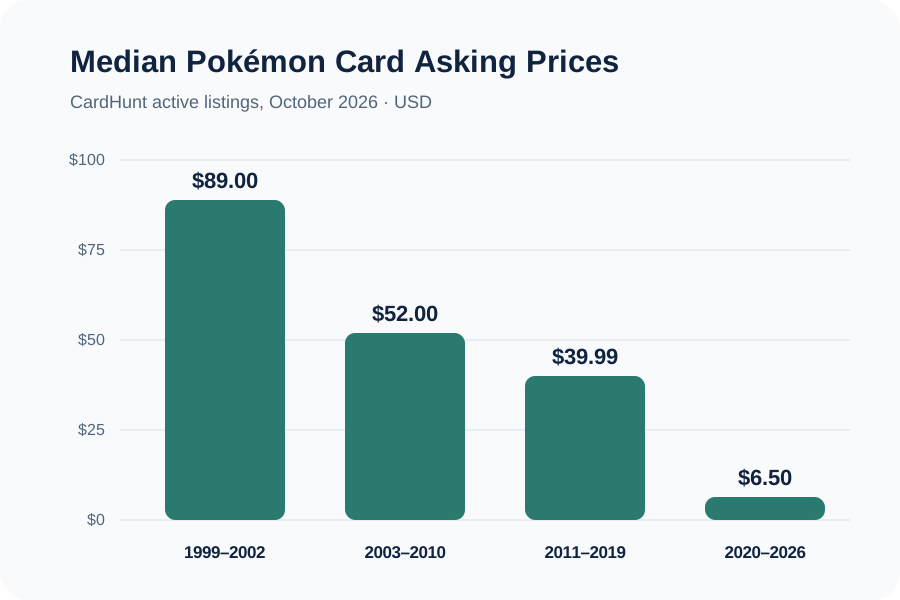
Source: CardHunt active listings, October 2026. Prices in USD.
The earliest group had a median asking price of $89, compared with just $6.50 for modern cards, a difference of approximately 13.7 times.
The pattern was consistent across the four periods, with older cards showing higher median asking prices.
Of course, this doesn't mean every vintage card is more valuable than a modern one. Each group contains a different mix of sets, characters, rarities, conditions and graded cards.
Still, the difference illustrates the strong asking prices associated with earlier Pokémon releases in the CardHunt index.
Why Do Vintage Pokémon Cards Attract Higher Prices?
Nostalgia plays a major role. Early releases such as Base Set, Jungle, Fossil and Team Rocket remain especially appealing to collectors who grew up with Pokémon in the late 1990s and early 2000s.
But condition and grading are also important factors.
Many early Pokémon cards were played with, traded and stored without protection. Finding desirable vintage cards in excellent condition can therefore be challenging, particularly when chasing highly graded examples.
A PSA 10 vintage holographic, for example, may command a substantial premium over the same card in a lower grade.
This creates another opportunity for collectors: finding raw, or ungraded, vintage Pokémon cards with the potential to receive a high grade and increase in resale value.
Modern cards can also attract impressive prices when graded, but a high grade alone doesn't guarantee a premium. The number of cards receiving that grade, overall demand and grading costs all influence the potential return.
Ultimately, age, condition, rarity and grading all contribute to what collectors are willing to pay, and an older card isn't automatically worth more than a desirable modern release.
Modern Pokémon Cards Dominate Available Listings
Despite the higher median asking prices for older releases, modern cards account for the overwhelming majority of Pokémon listings in our database.
Of the 152,553 listings analyzed, 134,919 were cards released between 2020 and 2026, representing 88.4% of the total.
Modern releases also had the lowest median asking price at $6.50.
Across all Pokémon listings tracked by CardHunt:
- More than half were priced below $10.
- 76% were priced below $50.
- The overall median asking price was $8.99.
While rare and valuable cards often dominate the headlines, these figures show that much of the Pokémon inventory we track is relatively affordable.
Charizard Still Commands Attention
Charizard remains one of the most recognisable and sought-after Pokémon characters, and its asking prices stood out in our analysis.
CardHunt tracked 12,937 Charizard listings with a median asking price of $115.
That's approximately 12.8 times the overall Pokémon median of $8.99.
The comparison isn't like-for-like, since Charizard listings include many different sets, years, rarities and grades. But it highlights how character popularity can be associated with substantial differences in asking prices.
For collectors, finding the right Charizard card at the right price can be just as important as deciding between vintage and modern releases.
What Does This Mean for Pokémon Collectors?
Our findings show that older Pokémon cards carry higher median asking prices within the CardHunt index, while modern cards offer a much larger selection of relatively inexpensive listings.
For collectors, these pricing patterns are useful starting points, but they don't determine whether an individual card is a good deal.
Before buying, compare the exact set, card number, rarity, condition and grade. If you're considering buying an ungraded card to submit for grading, it's also worth checking graded population reports, recent completed sales and potential grading costs.
That's where CardHunt can help. By bringing listings from multiple marketplaces into one search, we make it easier to compare prices and discover cards that might otherwise be overlooked.
Whether you're chasing a vintage holographic, hunting for a graded Charizard or completing a modern set, search CardHunt to compare available listings and find the right card at a competitive price.
Compare Pokémon Card Listings
Search CardHunt for vintage cards, modern cards, and Charizard listings from multiple marketplaces.
The Bottom Line
Our analysis of more than 150,000 Pokémon listings found a substantial difference between vintage and modern asking prices.
Cards released between 1999 and 2002 had median asking prices nearly 14 times as high as those from 2020 to 2026. Meanwhile, modern cards accounted for more than 88% of listings, and Charizard stood out with a median asking price of $115.
The findings reinforce something collectors already know: release year, character, rarity, condition and grading all matter when evaluating a Pokémon card.
And while older cards may command higher asking prices overall, finding good value still comes down to comparing the exact card across available sellers.
Interested in Sports Cards Too?
We also analyzed rookie-card asking prices across baseball, basketball and football, discovering that rookie cards had median asking prices 3.8 to 4.6 times as high as other cards.
Read our companion article: [Are Rookie Cards Really Worth More?](/content/are-rookie-cards-worth-more/)
Methodology
CardHunt analyzed 152,553 active Pokémon marketplace listings in October 2026. Figures represent seller asking prices in USD, not completed sales. The database prioritises popular and actively traded cards and is subject to marketplace coverage and crawl limitations. Release-period groups cover 151,423 listings, with 1,130 listings outside the displayed groups. Results describe the CardHunt index rather than the entire Pokémon market. The data does not isolate the effects of age, rarity, condition or grading on asking prices.